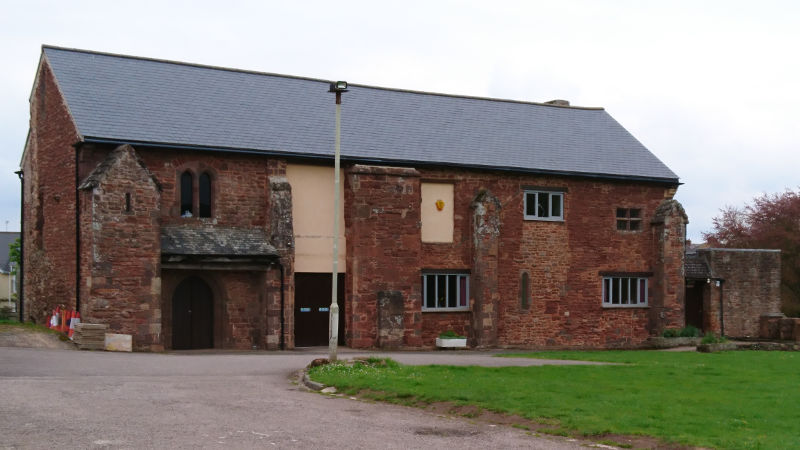

St Katherine’s Priory in Polsloe was founded as a Benedictine nunnery before 1159 and was dissolved in 1539. It lies about 2km outside Exeter’s medieval City Walls, and is now an oasis of green surrounded by suburbia.
A nunnery was a settlement built to sustain a community of religious women, and St Katherine’s is significant as one of only three in Devon and Cornwall. It is also one of the few to have had an extensive archaeological excavation and fabric survey.
Excavations showed that the Priory followed the traditional medieval monastic plan: a church and three ranges of two-storeyed buildings grouped around a square cloister, and other nearby buildings.
The standing remains are from the west range of the cloister. The buried remains include the church on the north side, the southern part of the west range, the south and east ranges, and the kitchens, other buildings, cemetery and water management system.
The present building dates from around 1300, and is built mainly of Poltimore sandstone with dressings of volcanic trap, and some Heavitree Stone and Salcombe Stone. It followed an earlier building of similar proportions, mainly of Heavitree Stone. Parts of this are still visible in the east end of the north wall and the foundations of the east and south walls.
As the Heavitree quarries didn’t start to be worked heavily until the 1350s, this must be one of the earlier uses of Heavitree Stone.
Sources:
- Exeter City Council Archaeological Advisory Committee, 1980 – http://archaeologydataservice.ac.uk/archives/view/exeter_parent_2015/downloads.cfm
- Devon & Dartmoor Historic Environment Record – http://www.heritagegateway.org.uk/Gateway/Results_Single.aspx?uid=MDV15173&resourceID=104
- Historic England Listed Building – https://www.historicengland.org.uk/listing/the-list/list-entry/1017595
- Historic England Pastscape – https://www.pastscape.org.uk/hob.aspx?hob_id=448333
See also:
- St Katherine’s Priory is now a community centre with a Facebook page – https://www.facebook.com/St-Katherines-Priory-577140365650854/
- Nicholas Orme (2014) “The Churches of Medieval Exeter”
- Exeter Memories – http://www.exetermemories.co.uk/em/_buildings/polsloepriory.php