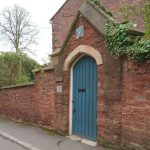
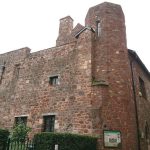
W Wynard's Hospital

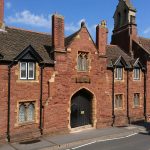
W Wynards - credit Clare Bryden

God’s House, also known as Wynard’s Hospital, was founded in 1436. The plan comprises twelve two-storeyed almshouses for twelve poor men; the chapel of the Holy Trinity along the street frontage; and accommodation for the chaplain. It was built of Heavitree Stone throughout, during the medieval period when the Heavitree quarries were at maximum production. … Read more

V Victoria Park Road

V Victoria Park Road - credit Clare Bryden

Heavitree Stone is not just used in the historic buildings of Exeter, but in many boundary walls around the city. Along Wonford Road, between the Nuffield Hospital and Lyndhurst Road, there is about a third of a mile of walling with some good examples of different stone, dressing, and building techniques. Much of it is … Read more

U Underground Passages

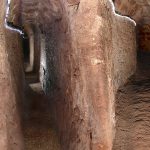
U Underground Passages - courtesy of Exeter City Council

The Underground Passages are access tunnels to Exeter’s medieval water supply system. These were large arched stone conduits, through which water was carried in lead pipes from springs to the north east of the city. They have been altered and extended many times over the centuries, but it is extremely rare to find such a … Read more

T Trews Weir Mill

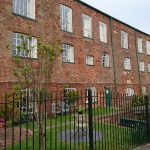
T Trews Weir Mill - credit Clare Bryden

Take a leisurely walk along the left bank of the Exe, and you will reach Trews Weir and the striking building that used to house a paper mill. Trews Weir Mill was probably originally built as a cotton spinning mill. There is a stone dating it to 1780 on the front of the building, which … Read more

S Stepcote Hill

S Stepcote Hill - credit Clare Bryden

The ancient cobbled slope of Stepcote Hill and the buildings in West Street at its base have as much historic interest as any part of Exeter. Nos. 5 and 7 West Street, including No.15 Stepcote Hill, are a pair of characterful late-medieval houses. No.5 has a Heavitree Stone back wall and basement storey, with two … Read more

R Rougemont Castle

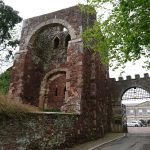
R Rougemont Castle - credit Clare Bryden

Rougemont is a natural rock knoll of volcanic trap, and the source of the second most important building material in Exeter! Trap and Heavitree Stone can easily be told apart. Trap is purple rather than red; it often contains small round holes where air bubbles were trapped as the rock cooled; and it is easier … Read more

Q Quarries

Q Quarries - credit Clare Bryden

The Heavitree quarries are where our stories begin, in the Permian geological time period. Between 250 and 300 million years ago, Devon was a tropical desert. Occasional storms caused flash floods, which dumped large amounts of loose rock, sand and mud. Over time this gravelly sediment built up and was compacted together. Over the next … Read more

P St Petrock's Church

P St Petrock's Church - credit Clare Bryden

St Petrock’s has been described as “among the most confusing of any church in the whole of England.” The first record of the church is in about 1200, and the site may well be older, but everything visible now is late medieval or later. The core plan of the church was a simple nave and … Read more

O Old Deanery wall

O Old Deanery - credit Clare Bryden

The Old Deanery wall is a nice stretch of dressed but uncoursed Heavitree Stone, with stone capping. There is a gateway facing the Cathedral with an arch in limestone. The Old Deanery itself was four blocks and adjoining chapel. The chapel existed by 1200, but what we have now is 15th century, built of Heavitree … Read more

N St Nicholas Priory

N St Nicholas Priory - credit Clare Bryden

The Benedictine Priory of St Nicholas was founded in 1080-87, and its standing remains are among the oldest surviving medieval buildings in Exeter. Originally it followed the standard layout of a medieval monastery: a church on the south side and three ranges of two-storeyed buildings grouped around a square cloister. The west and north ranges … Read more

Privacy Overview

This website uses cookies so that we can provide you with the best user experience possible. Cookie information is stored in your browser and performs functions such as recognising you when you return to our website and helping our team to understand which sections of the website you find most interesting and useful.

You can adjust all of your cookie settings by navigating the tabs on the left hand side.