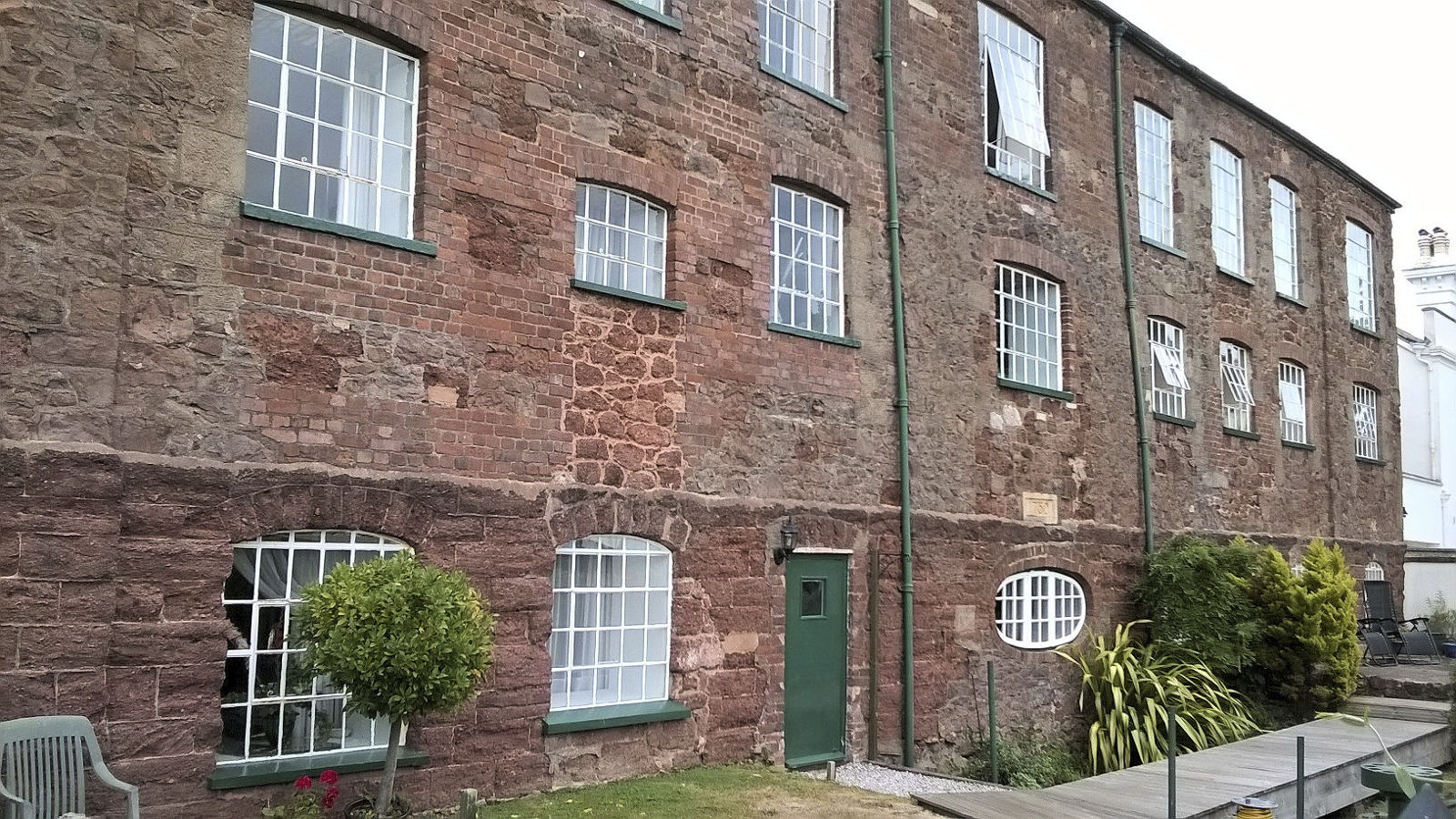
Take a leisurely walk along the left bank of the Exe, and you will reach Trews Weir and the striking building that used to house a paper mill. Trews Weir Mill was probably originally built as a cotton spinning mill. There is a stone dating it to 1780 on the front of the building, which makes it a very early factory. It was converted to a paper mill in 1835, operating until 1982, and has now been converted again into apartments.
For a water-powered mill it is relatively large, with a wide plan, and a fairly symmetrical frontage of three storeys and nine bays. If you look closely you can see that the central bay bulges out, and the first and last bays project slightly.
The ground floor is a well-built plinth of dressed Heavitree Stone, laid in horizontal courses. Above this is rubble, a patchwork quilt of Heavitree Stone, brick and other stone. There has been some ‘refenestration’, that is rebuilding and replacement of windows. The large section of Heavitree Stone patching in the third bay is particularly intriguing.
Where was the water wheel? There is a rectangular basin in front of the central bay, with an iron-mounting beam for a turbine, which could have been an external wheel chamber.
Sources:
- Historic England image caption - https://historicengland.org.uk/services-skills/education/educational-images/factory-trews-weir-lane-exeter-6991
- Archaeology Data Service - http://archaeologydataservice.ac.uk/archsearch/record?titleId=1102392
See also:
- Exeter Memories - http://www.exetermemories.co.uk/em/_commercial/trews.php